STARPWN-2026-Writeup
Glittercity OST2
| Category | Space Communication & RF |
| Points | 500 |
| Solves | 17 |
Description
The grid goes dark.
Before shutdown, you swept the final useful arc over the Mojave just below one meter. The dish was tracking a dead machinery that once watched the whole planet, now drifting as one of the largest ghosts in orbit.
The receiver came back. Dead-Eye calling. Trying to reach back home.
Three fractured calls make one. It has forgotten letters, now it speaks in lines. Burn away the repeating veil forged from its number, high byte first.
Find the ghost. Recover the message.
Attachments: Glittercity-OST2.mp3
Solution
Steps
1. Convert the MP3 to WAV and isolate the stereo difference channel
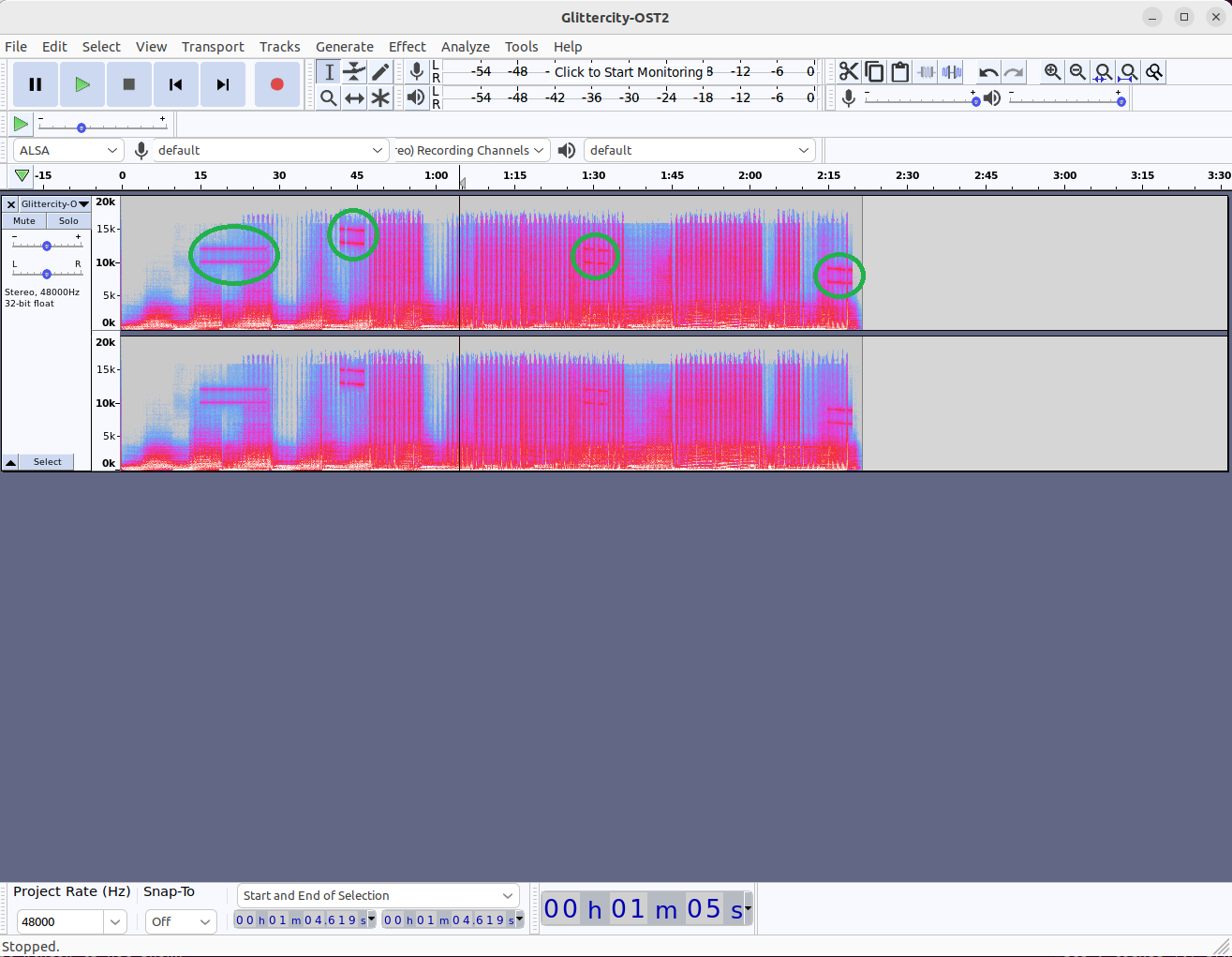
Opening the MP3 file in Audacity and inspecting its spectrum reveals four distinct 2-FSK signals.
And convert the MP3 to 48 kHz stereo PCM:
ffmpeg -i Glittercity-OST2.mp3 -ar 48000 -ac 2 ost2.wav
The hidden transmissions are most clearly visible in the stereo difference channel. Extract it as a mono WAV:
ffmpeg -i ost2.wav \
    -filter_complex "pan=mono|c0=0.5*c0-0.5*c1" \
    -ar 48000 \
    side.wav
2. Decode the ground-calibration transmission
Before the three Dead-Eye calls, there is a separate 2-FSK transmission around the 15-second mark.
This signal acts as a known-good demodulation reference. Analysis gives:
python3 extract_decode_ost2_ground_calibration.py Glittercity-OST2.mp3
[*] Input              : /home/jhmoon/starpwn/Glittercity-OST2/Glittercity-OST2.mp3
[*] Extracted interval : 14.0000 - 30.0000 s
[*] Stereo WAV         : /home/jhmoon/starpwn/Glittercity-OST2/ost2_ground_calibration/ground_calibration_stereo.wav
[*] Side-channel WAV   : /home/jhmoon/starpwn/Glittercity-OST2/ost2_ground_calibration/ground_calibration_side.wav
[*] Sample rate        : 48000 Hz
[*] Baud rate          : 300.0
[*] Samples/symbol     : 160
[*] Estimated tones    : 10212.52 / 12212.52 Hz
[*] Symbol phase       : 50 samples
[*] Tone mapping       : low=1, high=0
[*] HDLC flags found   : 167
[+] CRC-valid frames   : 8
The calibration signal contains repeated HDLC frames. After locating 0x7E flags, removing HDLC bit stuffing, and validating the FCS, eight identical CRC-valid frames are recovered:
CHANDELIER-7
STATUS=GROUND CALIBRATION
Example decoder output:
[+] Frame 01: bits 420..757, destuff 329 -> 328 bits (removed 1), FCS received=0x7E95, calculated=0x7E95 [OK]
[+] Frame 02: bits 901..1238, destuff 329 -> 328 bits (removed 1), FCS received=0x7E95, calculated=0x7E95 [OK]
[+] Frame 03: bits 1382..1719, destuff 329 -> 328 bits (removed 1), FCS received=0x7E95, calculated=0x7E95 [OK]
[+] Frame 04: bits 1863..2200, destuff 329 -> 328 bits (removed 1), FCS received=0x7E95, calculated=0x7E95 [OK]
[+] Frame 05: bits 2344..2681, destuff 329 -> 328 bits (removed 1), FCS received=0x7E95, calculated=0x7E95 [OK]
[+] Frame 06: bits 2825..3162, destuff 329 -> 328 bits (removed 1), FCS received=0x7E95, calculated=0x7E95 [OK]
[+] Frame 07: bits 3306..3643, destuff 329 -> 328 bits (removed 1), FCS received=0x7E95, calculated=0x7E95 [OK]
[+] Frame 08: bits 3787..4124, destuff 329 -> 328 bits (removed 1), FCS received=0x7E95, calculated=0x7E95 [OK]
[+] Unique payloads    : 1

--- Payload 1 ---
CHANDELIER-7
STATUS=GROUND CALIBRATION
This calibration transmission is important because it establishes the physical-layer parameters and, in particular, the FSK polarity used later for the Dead-Eye transmissions.
It also links OST2 back to OST1, where CHANDELIER-7 appeared together with its TLE.
3. Identify and extract the three Dead-Eye calls
After the calibration signal, three separate Doppler-shifted 2-FSK transmissions appear later in the recording.
Extract them from side.wav with a small amount of padding:
ffmpeg -i side.wav -ss 41.4   -t 5.4 call1.wav
ffmpeg -i side.wav -ss 88.0   -t 5.4 call2.wav
ffmpeg -i side.wav -ss 134.65 -t 5.4 call3.wav
The three calls carry the same frame, but different portions of each reception are degraded. This corresponds directly to the challenge hint:
Three fractured calls make one.
4. Demodulate each call with GNU Radio
Use GNU Radio Companion with the gr-satellites AFSK Demodulator.
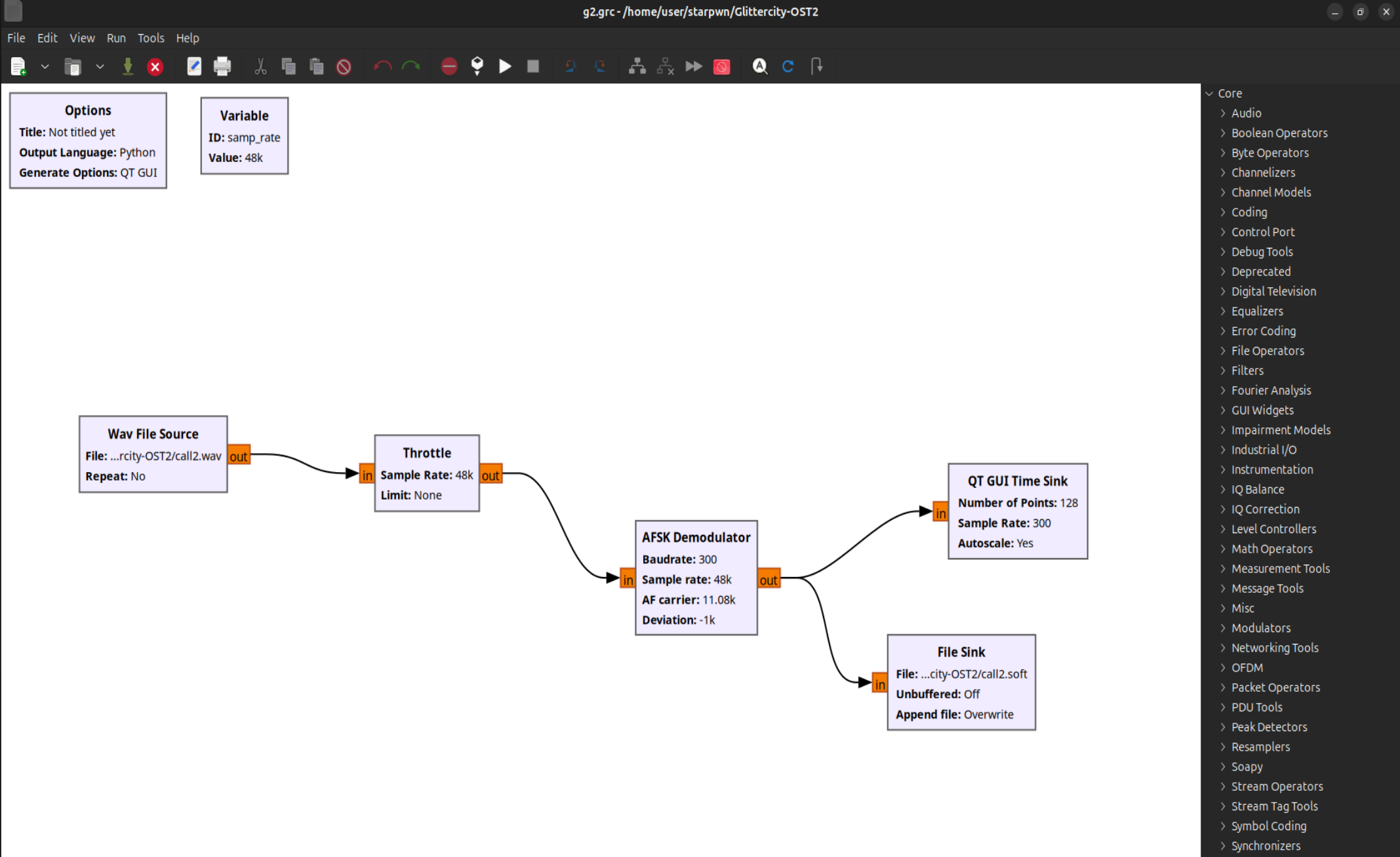
A minimal flowgraph is:
Wav File Source
      |
      v
Throttle
      |
      v
AFSK Demodulator
      +----> QT GUI Time Sink
      |
      +----> File Sink
Recommended settings:
Sample rate : 48000
Baudrate    : 300
Deviation   : -1000 Hz
IQ input    : False
The negative deviation preserves the polarity established by the ground-calibration transmission:
low tone  = 1
high tone = 0
Use an AF carrier appropriate for each Doppler-shifted call:
Call 1 : ~14000 Hz
Call 2 : ~11080 Hz
Call 3 : ~8100 Hz
For Call 2, nearby values such as 11040, 11060, and 11080 Hz can be tested; 11080 Hz produced a clean synchronization result in this solve.
The GNU Radio flowgraph outputs normalized float soft symbols rather than immediately forcing every symbol to 0 or 1.
For example, Call 1 yields:
preamble start symbol : 101
body start symbol     : 165
ASM errors            : 0
preamble errors       : 0
and begins with:
1a cf fc 1d 00 9f d9 fd 11 1d 56 08 42 76 90 d5
The first four bytes are the CCSDS Attached Sync Marker:
1A CF FC 1D
5. Soft-combine the three demodulated streams
Align the three .soft streams using the alternating 64-symbol preamble and the 1A CF FC 1D ASM.
Normalize the amplitudes of the three soft streams and sum them symbol-by-symbol:
soft_combined = soft1 + soft2 + soft3
bit = 1 if soft_combined > 0 else 0
This is more robust than hard majority voting. In a damaged section, the affected call produces soft values closer to zero, so the cleaner receptions dominate naturally.
As a validation step, explicitly masking the large degraded sections before summing gives exactly the same final 1336-bit result:
difference = 0 / 1336 bits
The resulting frame is 167 bytes and has the following structure:
1A CF FC 1D | 00 9F | [160-byte ciphertext] | 45
^^^^^^^^^^^   ^^^^^                           ^^
CCSDS ASM     length - 1                      CRC-8/DVB-S2
The two-byte length field is big-endian:
0x009F + 1 = 160 bytes
which matches the ciphertext length exactly.
6. Find the ghost — ENVISAT
The challenge description points to ENVISAT, the defunct ESA Earth-observation satellite that lost contact in 2012 and remains one of the largest uncontrolled spacecraft in orbit.
Its NORAD catalog number is:
27386
which is:
0x6AFA
The hint:
forged from its number, high byte first
therefore gives the repeating byte sequence:
6A FA 6A FA 6A FA ...
7. Burn away the repeating veil
Apply the repeating XOR key to the 160-byte ciphertext only:
KEY = bytes.fromhex("6AFA")

plaintext = bytes(
    b ^ KEY[i % len(KEY)]
    for i, b in enumerate(ciphertext)
)
Do not include the ASM or the two-byte length field in the XOR stream.
Validate the decrypted payload with CRC-8/DVB-S2:
Received CRC   : 0x45
Calculated CRC : 0x45
Result         : OK
This confirms both the reconstructed frame and the XOR alignment.
8. Render the line-oriented message
The first two decrypted bytes are:
B3 07
which decode to:
width  = 0xB3 = 179
height = 0x07 = 7
This explains the challenge hint:
It has forgotten letters, now it speaks in lines.
The remaining bytes contain an MSB-first packed monochrome bitmap. Interpret the first:
179 × 7 = 1253 bits
as seven scan lines and render them as a PBM or PNG image.
The resulting image reads:

STARPWN{THIS_WAS_OFF_TOO_MUCH}
Key Files
| File | Description |
|---|---|
ost2.wav |
Full 48 kHz stereo WAV converted from the MP3 |
side.wav |
Stereo difference channel containing the hidden FSK transmissions |
ground_calibration_side.wav |
Extracted CHANDELIER-7 calibration transmission |
call1.wav / call2.wav / call3.wav |
Extracted Dead-Eye transmissions |
call1.soft / call2.soft / call3.soft |
GNU Radio AFSK soft-symbol outputs |
soft_sum.bin |
167-byte frame recovered by soft combining |
dead_eye_plain_160.bin |
Decrypted 160-byte payload |
dead_eye_message.pbm |
Reconstructed 179×7 monochrome bitmap |
g2.grc / g2.py |
GNU Radio flowgraph for AFSK demodulation |
decode_dead_eye.py |
Frame parser, CRC checker, XOR decoder, and bitmap renderer |
Exploit Code
#!/usr/bin/env python3
"""
Usage:
    python3 decode_dead_eye.py soft_sum.bin
"""

from pathlib import Path

ASM = bytes.fromhex("1ACFFC1D")
KEY = bytes.fromhex("6AFA")


def crc8_dvb_s2(data: bytes) -> int:
    crc: int = 0

    for byte_value in data:
        crc ^= int(byte_value)

        for _ in range(8):
            if (crc & 0x80) != 0:
                crc = ((crc << 1) ^ 0xD5) & 0xFF
            else:
                crc = (crc << 1) & 0xFF

    return int(crc)


def repeating_xor(data: bytes, key: bytes) -> bytes:
    return bytes(
        int(byte_value) ^ int(key[index % len(key)])
        for index, byte_value in enumerate(data)
    )


def unpack_msb_bits(data: bytes) -> list[int]:
    bits: list[int] = []

    for byte_value in data:
        value: int = int(byte_value)

        for bit_index in range(7, -1, -1):
            bits.append((value >> bit_index) & 1)

    return bits


frame = Path("soft_sum.bin").read_bytes()

assert len(frame) == 167
assert frame[:4] == ASM

payload_length = int.from_bytes(
    frame[4:6],
    byteorder="big",
    signed=False,
) + 1

ciphertext = frame[6:-1]
received_crc = int(frame[-1])

assert len(ciphertext) == payload_length

plaintext = repeating_xor(ciphertext, KEY)

calculated_crc = crc8_dvb_s2(plaintext)
assert calculated_crc == received_crc, "CRC mismatch"

width = int(plaintext[0])
height = int(plaintext[1])

bits = unpack_msb_bits(plaintext[2:])
bits = bits[: width * height]

pbm = [
    "P1",
    f"{width} {height}",
]

for row in range(height):
    row_pixels: list[str] = []

    for column in range(width):
        pixel = int(bits[row * width + column])
        row_pixels.append("0" if pixel != 0 else "1")

    pbm.append(" ".join(row_pixels))

Path("dead_eye_message.pbm").write_text(
    "\n".join(pbm) + "\n",
    encoding="ascii",
)

print(f"Bitmap: {width}x{height}")
print("FLAG: STARPWN{THIS_WAS_OFF_TOO_MUCH}")
Flag
STARPWN{THIS_WAS_OFF_TOO_MUCH}